The post Death By Eels: Murderous Gluttony and Stone-Cold Murder appeared first on The Eels of History: Dead Fish Stories.
]]>
Henry was not the only member of an English royal family reputed to have his death connected a dinner of murena. There is a story that Eustace IV (d. 1153), the son of King Stephen, choked to death on a plate of eels – a tale which suggests that Henry II owed his inheritance to not one, but two separate incidences of eel-related tragedy. It is, however, unlikely that Steven actually met his end this way. No account from the period attests to the story; the chroniclers of Steven’s day were quite silent about eels. The story first appears much later, unsourced, in twentieth-century historiography.[3]
Eels’ regicidal reputation was not limited to England, either. North of the border, the Scots had similar suspicions. Robert the Bruce’s physician, Maino de Maineri, wrote that the king consistently put his health at risk by eating “eels [murenae], which are by nature like lampreys [lampreda].” Maino complained that the king “risked many dangers” in eating eels because they were caught in “muddy and corrupt waters.”[4]

There was immediate precedent for concern: The Lanercost Chronicle records that the Scottish king Alexander III (d. 1286) had a diner of fresh eels (murena recenti) immediately before his own tragic death.[5] While the fish themselves were unrelated to the king’s death (he fell from his horse), the murena still seem prophetic in their role in the story.[6]
The chronicle tells us that during a feast Alexander sent a plate of the fish to one of his barons, urging the man to make merry because it was the Day of Judgement. To which the baron answered that, if it be Judgement Day, at least they would soon rise again with full bellies.[7] In the chronicle’s next line, the feast ends and the king rides off towards his fate (and presumed resurrection), prepared with a belly of murena.[8]
Eels didn’t just kill kings, either…plenty of regular English people met their end before a plate of eel. It turns out that eels were a popular dish to use for poisoning people. Everyone ate eels frequently, and the fish’s popularity (and strong fishy taste) made it a good choice if you were trying to kill with subtlety.
The fourteenth-century scholar and churchman Bartolemeus Anglicus (Bartholomew the Englishman), in his widely-read encyclopedia De Proprietatibus Rerum, relates in passing a story about a blind man man whose wife “gave him an adder with garlic in stead of an eel, that it might slay him.”[9] It didn’t work…the adder cured the man’s sight instead. In another, slightly later, version of this story the man, upon subsequently learning that he had unwittingly eaten a snake, immediately fell ill and died.[10] In both accounts, the couple’s unhappy marriage seems to have been sustained on a simple and regular diet of eels in garlic – which made it the perfect dish for killing your horrible husband.

These two stories echo the traditional English border ballad “Lord Randall” (Child 12), in which the titular character’s lover (or mother, depending on the version of the poem) feeds him a poisoned meal of “eels fried in a pan.”[11] The dinner kills off both Lord Randall and his scrap-loving hound. Here again, we can see that a plate of eels was common enough to be an unsuspicious vehicle for murder.
All this is to say that, when your estranged partner surprises you with a bowl of eels, you may want to think twice before tucking in.
Notes
[1] “Cum igitur … comedit carnes murenarum, que semper ei nocebant, et semper eas amabat. Cum autem medicus hoc comedi prohiberet, non adquievit rex salubri consilio.” Henry of Huntingdon, Historia Anglorum: The History of the English People, ed. and trans. Diana Greenway, Oxford Medieval Texts (Oxford: Clarendon Press, 1996), 490.
[2] Indeed, the term “surfeit of lampreys” developed a cultural life of its own that continues still. See, for example, Ngaio Marsh’s 1941 murder mystery by that name. Ngaio Marsh, Surfeit of Lampreys: Inspector Roderick Alleyn #10 (Felony & Mayhem Press, 2012).
[3] Amy R Kelly, Eleanor of Aquitaine and the Four Kings (Cambridge: Harvard University Press, 1950), 87.
[4] “Securius tune est huiusmodi pisces non comedere nam ego vidi tempore quo ego fui cum rege scotorum roberto de briis multos periclitari ex comestione mur?ne que eiusdem nature est cum lampreda. Verum est quod illa murena capta fuit in aqua lutosa et corrupta.” Caroline Proctor, “Physician to the Bruce: Maino De Maineri in Scotland,” The Scottish Historical Review 86, no. 221 (2007): 17.
[5] Joseph Stevenson, ed., Chronicon de Lanercost (Edinburgh, 1839), 116.
[6] The English chronicler at Lanercost, who never missed an opportunity to paint his northern neighbors as horrible, happily reports that Alexander fell from his horse after getting lost on a dark and stormy night while trying to make an assignation with his badly irreligious and unsuited bride-to-be. The Scots would come to see Alexander’s death as a tragedy, but the Lanercost scribe saw it as divine judgement for the king’s silly and reckless behavior. See: Stevenson, 116.
[7] “Cum ad prandendum ventum esset, inter sercula et pocula fronte serenata exennia de murena recenti misit uni baroni, mandans ei per armigerum laetum agere discubitum, et sciret judicii esse diem illum. Ille, inter gratias reserendas, facete dominor espondit, ‘Si hodie est dies judici,i resurgemus cito ventre replete.’” Stevenson, 116.
[8] A more focused study of eels in Scotland might do well to consider the title, Hey, MacMuraena!
[9] Bartholomaeus Anglicus, Batman Vppon Bartholome His Booke De Proprietatibus Rerum, Newly Corrected, Enlarged and Amended: With Such Additions as Are Requisite, Vnto Euery Seuerall Booke: Taken Foorth of the Most Approued Authors, the like Heretofore Not Translated in English. Profitable for All Estates, as Well for the Benefite of the Mind as the Bodie. 1582., ed. Stephen Batman, trans. John Trevisa (Ann Arbor, MI; Oxford: Text Creation Partnership, 2003), 114.
[10] Alexander Ross, Arcana Microcosmi (London, 1652), 131, EEBO, http://name.umdl.umich.edu/A57647.0001.001.
[11] Francis James Child, The English and Scottish Popular Ballads, Part I (Boston: Houghton, Mifflin and Company, 1882), 158–60, http://archive.org/details/englishandscotti01chiluoft.
The post Death By Eels: Murderous Gluttony and Stone-Cold Murder appeared first on The Eels of History: Dead Fish Stories.
]]>The post Raw Eels May Kill Your Hangover. And the Rest of You, Too. appeared first on The Eels of History: Dead Fish Stories.
]]>
As anyone in medieval England would have known, you should never eat raw eel. As it turns out, eel blood is toxic to mammals. In fact, it’s what Charles Richet used to prove the principle of anaphylaxis (a word of his own creation). He gave toxin derived from eel blood serum to dogs and recorded their decreased resistance to future, much smaller doses. His work on the subject won the 1913 Nobel Prize in Medicine. The toxin in eel blood breaks down when heated to 58-70º Celsius, so it’s easy enough to get rid of.[2] As people the world over known, cooked eels are fine. But raw ones are bad news.[3]

Interestingly, the connection between over-drinking and eels may have its roots as far back as the seventh century, when Isidore of Seville — that enormously influential early encyclopedist, cleric, and mansplainer — wrote that anyone who drinks alcohol in which an eel had been killed wills develop a strong distaste for the drink.[4] This piece of advice stuck with medieval writers, who repeated it, and it carried over into the Early Modern period as well.

The seventeenth-century botanist and writer Nicholas Culpeper came back to the legend in his most famous work, the Complete Herbal. Culpeper wrote about eels’ virtue as a cure for alcoholism, writing that the fish, “being put into wine or beer, and suffered to die in it, he that drinks it will never endure that sort of liquor again.[5] Which makes a certain degree of visceral sense.
It seems likely that this is the history that informs the modern idea that raw eels and bitter almonds was a medieval hangover cure. But such a reading mistakes the sources, and doesn’t take the fish themselves into account. Now, the medieval English did occasionally poisoned each other with eels…but that’s another story for another article. When they weren’t feeling murderous, thought, they certainly knew better than to compound a hangover with a venomous chaser of raw eel. And now so do you!
Notes
[1] See, for example: David L. Sloan and Christopher Shultz, The Hangover Survival Guide (Key West: Phantom Press, 2006), 74; Claire Suddath, “A Brief History Of: Hangover Cures,” Time, December 31, 2008, http://time.com/3958046/history-of-hangovers/.
[2] Friedrich-Wilhelm Tesch, The Eel: Biology and Management of Anguillid Eels, ed. P.H. Greenwood, trans. Jennifer Greenwood (London: Chapman and Hall, 2012), 40–41.
[3] Interestingly, bitter almonds are also a poisonous in large quantities, making this recipe especially unpleasant. See: Alfred Swaine Taylor, Medical Jurisprudence (Blanchard & Lea, 1856), 149.
[4] Isidore of Seville, The Etymologies of Isidore of Seville, trans. Stephen A. Barney (Cambridge, UK: Cambridge University Press, 2006), 275. In this same section Isidore noted that in the eels in the Ganges, in India, grew to 30 feet in length.
[5] Nicholas Culpeper, Culpeper’s Complete Herbal,: To Which Is Now Added, Upwards of One Hundred Additional Herbs, with a Display of Their Medicinal and Occult Qualities ; Physically Applied to the Cure of All Disorders Incident to Mankind. To Which Is Now First Annexed His English Physician Englarged, and Key to Physic, with Rules for Compounding Medicine According to the True System of Nature. Forming a Complete Family Dispensatory, and Natural System of Physic to Which Is Added Upwards of Fifty Choice Receipts, Selected from the Author’s Last Legacy to His Wife (London: Richard Evans, 1816), 252.
The post Raw Eels May Kill Your Hangover. And the Rest of You, Too. appeared first on The Eels of History: Dead Fish Stories.
]]>The post Bede’s Account of Wilfrid and the South Saxons appeared first on The Eels of History: Dead Fish Stories.
]]>
The fish make three separate appearances in Bede’s Historia Ecclesiastica, and at each instance they connect to issues of English identity and territory. The first comes within the history’s opening section, as Bede describes Britain and sets the geographic stage for his history. And the third famously connects the name of the town of Ely to the eels that swim in the surrounding fens. But it is Bede’s second mention of eels that is perhaps most interesting.
In the fourth book of his text, Bede relates the story of Bishop Wilfrid, who spent several years in exile in the kingdom of the South Saxons. Bede tells us that the kingdom had been suffering from a devastating three-year drought. Conditions were so bad that the region’s people had taken to mass suicide, throwing themselves into the sea in groups of 40 or 50.[2] During his time among them, Wilfrid worked to convert the pagan South Saxons. But before he could convince them to change faiths Wilfrid had to first gain their trust, which he accomplished by teaching them how to fish for their food.

Bede writes that “although the sea and the rivers of that land were rich in fish, the people only had skill in fishing for eels.”[3] So Wilfrid had his men collect the eel snares from all over the land, and then repurposed them as fish nets.[4] Casting the snares and nets into the sea, they pulled in a catch of nearly 300 fish of various species.[5] Wilfrid’s gave the greater part of these fish to the local people, and they, in turn, became more receptive to his teachings. Bede tells us that their eventual conversion brought a return of the rains, and an end to the famine.
There are several ways to read this story, including for its value as a historical narrative. Bede appears not to have been accurate in his description of the Saxons’ bewilderment at marine fishing – as Ann Hagen has noted, archeological evidence from the period shows that the people of the region were eating both eel and other fish at the time.[6] So they were perhaps not as helpless as Bede wants us to believe.
But radiocarbon analysis of human skeletal remains from the 6th and 7th centuries indicates that eels likely made up a greater part of the protein in the early English diet than either all other freshwater fish together, or all marine fish.[7] Eels formed an important enough part of the Saxon’s diet and economy that the law code governing the South Saxon’s next-door neighbors in Wessex during Wilifrid’s life makes specific mention of eel as one of the expected and taxable products of land (King Ine of Wessex expected 100 eels, along with other things, for every ten units of land).[8] So even if they were catching other fish, the South Saxons were still heavily reliant on eels.
And Bede’s account provides a realistic description of the problems that a severe drought would impose on a culture that relied largely on eels for sustenance. Eels are highly susceptible to drought; they live in rivers and wetlands, and when those habitats begin to dry up, regional eel populations experience both migration and die-off.[9] A severe, multiple-year drought in the south of England would have drastically reduced the eel catch and put the Saxon population in dire straits. Clearly, Bede viewed the situation as plausible enough to use as the basis for his history; he found it credible that the pagans would have relied heavily enough on eels that the fish’s disappearance would have had severe destabilizing effects on South Saxon society.
There is also a strong allegorical element to the story. Wilfrid teaching the pagans to fish as a gateway to conversion closely echoes the twinned Biblical stories of Peter and the miraculous draughts of fishes, with Wilfrid standing in as Christ and the South Saxons as Peter.[10] Read only as an allegory, the account might appear to condemn the South Saxons’ traditional reliance on eels as specifically un-English, and mark their shift away from eels as an important moment of cultural change.

But the story does not condemn eel eating – indeed, the pagans’ heavy reliance on a diet of eels gives Wilfrid both an opening to prove himself, and a solution to the drought’s devastating effects. There is no indication in the story that the Wilfrid expected the South Saxons to cease eating eels. Teaching them to fish with their eel nets was simply a mechanism of conversion. Bede leaves unspoken what happened to the eels after the South Saxons converted. But he does note that the rains returned in good measure, and the earth revived (descendit pluuia serena sed copiosa, terra refloruit).[11] And the eels would have returned with the rain.
This part of the story matters. The South Saxons’ conversion would have returned their eels to them, rewarding their faith. For Bede, being English meant being Christian, and so his story ends up not being one in which a diet of eels equates to paganism, but one in which proper faith and proper cultural identity connect positively to the fish.
Notes
[1] Natasha Dodwell, Sam Lucy, and Jess Tipper, “Anglo-Saxons on the Cambridge Backs: The Criminology Site Settlement and King’s Garden Hostel Cemetery,” Proceedings of the Cambridge Antiquarian Society 93 (2004): 98, 109.
[2] Bede, Historia Ecclesiastica, 231.
[3] Namque mare et flumina eorum piscibus abundabant sed piscandi peritia genti nulla nisi ad anguillas tantum inerat. Bede, Historia Ecclesiastica, 231.
[4] The word retibus is often translated as “nets”, which makes sense in terms of the use to which Wilfrid puts them, but less sense in terms of their initial purpose. Eels can be caught in nets, but these tend to be funneled fyke or weir nets which need to be finely woven. They can also be caught by the use of shore seines, but any culture using shore seines would not need instruction on using their nets to catch other fish. As often as not, eels were caught in reed traps. “Snare”, rather than “net” captures better the probable range of instruments that Wilfrid collected.
[5] “Collectis ergo undecumque retibus anguillaribus homines antistitis miserunt in mare et diuina se iuuante gratia mox cepere pisces diuersi generis CCC.” Bede, Historia Ecclesiastica, 231.
[6] Ann Hagen, A Second Handbook of Anglo-Saxon Food & Drink: Production & Distribution (Ely: Anglo-Saxon Books, 1995), 167.
[7] Alex Bayliss et al., Anglo-Saxon Graves and Grave Goods of the 6th and 7th Centuries AD: A Chronological Framework, ed. John Hines and Alex Bayliss, vol. 33, The Society for Medieval Archeology (Abingdon: Routledge, 2017), 118–30. Bayliss et al calculate the percentage of protein from eels at 10±7% for women and 8±5.8% for men, the protein from all other freshwater fish together at 8.5±6.3% and 7±5.3%, and from all marine fish together at 5.9±4.1% and 7.5±4.9%.
[8] F. L. Attenborough, The Laws of the Earliest English Kings (Cambridge University Press, 2015), 58–59.
[9] For a recent case study of drought affecting eel catches, see: Jellyman and Arai, “Juvenile Eels: Upstream Migration and Habitat Use,” 278–79.
[10] Luke 5: 1-11; John 21: 1-14.
[11] Bede, Historia Ecclesiastica, 231.
The post Bede’s Account of Wilfrid and the South Saxons appeared first on The Eels of History: Dead Fish Stories.
]]>The post Getting Used to It: Churchill’s Eel Metaphor appeared first on The Eels of History: Dead Fish Stories.
]]>
Modern English has little use for eels in either metaphor or idiom, so Churchill’s aphorism stand out. Only the fish’s slipperiness has remained axiomatic; outside of discussions of the actual animal, the expression “slippery as an eel” (or, alternatively, “slick as an eel”) marks the only place that eels show up consistently in current English language usage. [3] It can describe a desired thing which is hard to hold onto, or – most often – an untrustworthy person or someone who cannot be pinned down or caught: a politician or a criminal.[4]
But Churchill’s metaphor use was quite different, and was unusual enough to stand out — both in his time and in ours. So how did he come up with it? Where did it come from? It turns out that the axiom was not original to Churchill at all. In fact, the saying was at least 150 years old when Churchill used it, and had been in popular use in England throughout that time. But the meaning of the expression had changed over that time, shifting as the English became increasingly less acquainted with the mechanics of skinning eels.
The earliest written version of the expression appears to come from Sir Peter Beckford’s popular 1781 book, Thoughts on Hunting in a Series of Familiar Letters to a Friend. In a section dealing with the proper disciplining of hounds, Beckford recounted a story of a gentleman who, while out hunting, comes upon a peasant girl skinning live eels. Taken aback by the process, he asks her if the practice were not cruel. “‘O not at all, Sir,’ replied the girl; ‘They be used to it.’”[5]

At its core, this statement is curious. There is no evidence prior to Beckford for this perception of eels, and in fact most earlier writing about skinning eels suggested the fish very much minded losing their hides. It is unclear, then, whether Beckford was passing along an actual contemporary saying, or whether he himself invented it.
Regardless, the turn of phrase quickly gained axiomatic traction. The next year Horace Walpole, the Earl of Oxford, reproduced the line from Beckford’s book almost verbatim as a metaphor while complaining over the tepid English reaction to the loss of Menorca to the Spanish and French. [6] It is uncertain whether Walpole had read Beckford, or if they were both employing a commonplace phrase.
The idiom appears frequently during the next several decades in debates over abolition. In 1782 William Windham said in a speech before Parliament that those people arguing that slaves could wait several more years for their freedom were “like the person who, when charged with cruelty for skinning eels alive, answered, they were used to it.”[7] Moving forward, the phrase became relatively commonplace in nineteenth century England, showing up in a surprisingly wide range of sources.[8] This, roughly, was the background that informed Churchill’s comments.
On its face, this short history of Churchill’s expression would seem to suggest that it was grounded in an experiential understanding of the fish – a linguistic echo of a common belief. But, in fact, the idiomatic use of the phrase is almost entirely about cultural separation from eels by the educated and well-off.
In Beckford’s original story, his gentleman shows a marked surprise at the process of skinning eels that would have been wholly foreign to earlier Englishmen, both real and literary. The gentleman might eat eels, but he is far removed from any other interaction with them. And Beckford offers the story as a way of critiquing people who rely on received folklore to justify the cruel treatment of animals; the handlers who mistreat his hounds are as wrong as this peasant girl with her eels.
This was the sense that the idiom had in its early usage. Walpole, Windham, and others deployed the phrase as a means of describing either uneducated people who foolishly believed something that was patently false, or people who hypocritically used traditional beliefs to justify their positions. But the meaning quickly shifted as the phrase became more popular, and it is clear that the English came to believe that eels did, in fact, become habituated to the pain of skinning. Where Windham had used the phrase to talk about people with a misunderstanding of slaves’ suffering, Lord Byron took the idiom at face value in his epic 1824 poem Don Juan. Describing slaves awaiting sale in the markets of Constantinople he wrote that, while most slaves seemed distraught, the Africans did not: “The negoes more philosophy display’d / Used to it, no doubt, as eels are to be flay’d.”[9]
Byron was not alone in this shifting usage. The idea seems to have developed into something of an urban myth, with enough writers taking up the phrase in earnest during the 1820s that the philosopher Jeremy Bentham felt compelled to push back against it. In his 1832 pamphlet Boa Constrictor, he stressed that “no eel is used to being skinned successively by several persons, but one in the same person is used successively to skin many eels.”[10] The editor of the London Quarterly Review applauded Bentham’s efforts shortly thereafter, proclaiming that this “formal refutation of the common fallacy as to eels” was “one of the most important services rendered by Mr. Bentham and his disciples to the world.”[11]

Despite this endorsement, Bentham’s protestations fell on relatively deaf ears. For most of the nineteenth century, English authors continued to use the metaphor with the steady confidence of people who had never actually tried to take away an eel’s skin. Beckham’s initial use, which demonstrated an elite distance form eel culture, had given way to later applications that show an equal detachment among a much wider range of English people.
So when Winston Churchill spoke about politicians needing to accustom themselves to political cartoons, or about Londoners becoming hardened to the horrors of the Blitz, this was the linguistic tradition he was coming from: one in which the infrequent use of eels in figurative language was removed from any level of experiential cultural familiarity. The metaphor might have been wrong, and divorced from its original meaning. But Churchill, like other English people of his era, had gotten used to it.
Notes
[1] Winston Churchill, “Cartoons and Cartoonists,” The Strand Magazine 81 (1931): 586. He later republished this essay along with other works in his 1932 book, Thoughts and Adventures.
[2] Richard Langworth, ed., Churchill By Himself: The Definitive Collection of Quotations (Philadelphia: PublicAffairs, 2008), 29.
[3] David Righton and Mandy Roberts, “Eels and People in the United Kingdom,” in Eels and Humans, ed. Katsumi Tsukamoto and Mari Kuroki, Humanity and the Sea (Tokyo: Springer Science & Business Media, 2013), 6; Robert Allen Palmatier, Speaking of Animals: A Dictionary of Animal Metaphors (Greenwood Publishing Group, 1995), 350; Sarah Zielinski, “Find Your Fishy Metaphor,” Smithsonian, accessed January 20, 2019, https://www.smithsonianmag.com/science-nature/find-your-fishy-metaphor-23790557/.
[4] Palmatier, Speaking of Animals, 350.
[5] Peter Beckford, Thoughts Upon Hunting: In a Series of Familiar Letters to a Friend, 4th ed. (London, 1802), 116. Italics in the original. Beckford included this vignette again in a different book published the same year. See: Peter Beckford, Thoughts upon Hare and Fox Hunting, in a Series of Letters (London, 1781), 106.
[6] Horace Walpole, Letters of Horace Walpole, Earl of Oxford to Sir Horace Mann, His Britannic Majesty’s Resident at the Court of Florence, From 1760-1785, vol. II (Philadelphia: Lea & Blanchard, 1844), 233.
[7] John Almon, John Debrett, and John Stockdale, The Parliamentary Register, or History of the Proceedings and Debates of the House of Commons During the Second Session of the Seventeenth Parliament of Great Britain, Vol. 32 (London: Debrett, 1792), 401.
[8] For examples of the breadth of the range of materials in which the metaphor appears, see: “The Physiological Errors of Teetotalism,” The Westminster and Foreign Quarterly Review, July 1855, 123; David Livingstone and Charles Livingstone, Narrative of an Expedition to the Zambesi and Its Tributaries: And of the Discovery of the Lakes Shirwa and Nyassa, 1858-1864 (New York: Harper & Bros., 1866), 544; Cuthbert Bede, The Adventures of Mr. Verdant Green: An Oxford Freshman (London: James Blackwood & Co., 1885), 163; Michael MacMillan, The Promotion of General Happiness: A Utilitarian Essay (London: Swan Sonnenschein & Co., 1890), 7.
[9] George Gordon Byron, The Complete Poetical and Dramatic Works of Lord Byron: With a Comprehensive Outline of the Life of the Poet, Collected from the Latest and Most Reliable Sources (D. McKay, 1883), 507.
[10] Jeremy Bentham, The Works of Jeremy Bentham, Part VI. (Edinburgh: W. Tait, 1838), 558. This was not the only occasion that Bentham used this image; he had earlier written that there was no more sympathy for human suffering in the hearts of men “than in the cook’s for the eels she is skinning.” See: Jeremy Bentham, Indications Respecting Lord Eldon: Including History of the Pending Judges’-Salary-Raising Measure (London: Robert Heward, 1825), 74.
[11] John Gibson Lockhard, ed., “Review: The French Cook. A System of Fashionable and Economical Cookery: Adapted to the Use of English Families Etc. By Louis Eustace Ude, Ci-Devant Cook to Louis XVI and the Earl of Sefton Etc. Etc. Etc. 12th Edition,” The London Quarterly Review, 1835, 81, editor’s note.
The post Getting Used to It: Churchill’s Eel Metaphor appeared first on The Eels of History: Dead Fish Stories.
]]>The post Feaguing Before Ginger: A Lively Horse Discussion appeared first on The Eels of History: Dead Fish Stories.
]]>Among the tricks of the trade was something called “feaguing,” which Francis Grose, in his 1785 Classical Dictionary of the Vulgar Tongue, says means “to put ginger up a horse’s fundament, and formerly, as it is said, a live eel, to make him lively, and carry his tail well.”[1] Grose goes on to note that the practice was so wide-spread that “a forfeit is incurred by any horse-dealer’s servant, who shall shew a horse without first feaguing him.”[2] We still have the phrase “to ginger up a horse,” but before they used ginger, shady horse merchants used eels.

Eels may not have been a commonly-used tool anymore by Grose’s day, but earlier English writers spoke of them with more familiarity. The humorist poet Edward Ward, in his 1700 “A Song Upon Dancing,” wrote that dancers “skip with nimble force / As Eels i’th’ belly of a Horse / Which Jockies use each Market-Day / To make ‘em dance, as People say.” [3] Ward, like Grose, may be professing a lack of first-hand knowledge – it depends on what his “as People say” refers to – but he at least seems to believe that it was happening in his day. Writers from the previous century certainly were even more sure.

A young John Milton made reference to feaguing in his ribald 1628 Latin poem Prolusion VI, in a section mocking his fellow Cambridge students. In reference to “certain Irish birds” (aves quaedam Hibernicae) he says that they are “more useful to grooms because they are by nature lively and brisk and prancing, and if they were forced into the anus of scraggly horses would make them livelier and quicker than if they had ten live eels in their bellies.”[4] Milton’s statement is far more affirmative than Ward’s, and he was not alone in speaking about feaguing with eels as common practice.

In 1616, friends of the famously late poet and politician Thomas Overbury republished his most well-known work, the poem “Wife,” along with an array of poetic caricature sketches of unsavory types of people written by anonymous authors.[5] One of those poems detailed the characteristics of “An Arrant Horse-Courser,” and noted that (among other unsavory habits) the man knows how cover up diseases and defects of all sorts. “For powding his [the horse’s] eares with / Quicksilver, and giuing him suppositories / of live eels he’s expert.”[6] As with Milton’s poem, there is no “as is said” or “formerly” in this description, and the author does not put distance between himself and what he portrays as an established practice. Nor, for that matter, does he mention ginger, or other instruments for feaguing horses that appear later.
At the start of the seventeenth century, it seems, eels were the way you spirited up a horse for sale. And everybody from university students to the king’s councilors knew – or, at least, believed – it to be true.[7]
Notes
[1] Francis Grose, “Feague,” in Classical Dictionary of the Vulgar Tongue (London, 1796).
[2] Grose.
[3] Edward Ward, The Dancing-School with the Adventures of the Easter Holy-Days. (London: J. How, 1700), 6. Italics in original.
[4] “Has igitur arbitror agasonibus utiliores futuras; nam cum sint naturae vividae vegetae et saltaturientes, si equis strigosis per podicem ingerantur reddent eos protinus vivaciores et velociores quam si decem vivas anguillas in ventre haberent.” John Milton, “Prolusion VI,” in Latin Writings: A Selection, ed. and trans. John Hale, Bibliotheca Latinintatis Novae (Assen: Van Gorcum & Comp., 1998), 88. Hale, the editor, seems unfamiliar with feaguing, because he makes a note to say that, at this point, Milton’s comparisons are becoming “almost surreal and magical.”
[5] Overbury’s death in 1613 became an enormous scandal in its day. He expired while a prisoner in the Tower of London, and it eventually came out that he had been poisoned at the direction of a court conspiracy that included Overbury’s best friend, the friend’s married love interest, and King James himself. The lurid tale involved political intrigue, lust, infidelity, money, and betrayal, and essentially reads as a work of bad historical fiction.
[6] Sir. Thomas Overbury, “An Arrant Horse-Courser,” in Sir Thomas Ouerburie His Wife with New Elegies Vpon His (Now Knowne) Vntimely Death : Whereunto Are Annexed, New Newes and Characters / Written by Himselfe and Other Learned Gentlemen. (London, 1616), https://quod.lib.umich.edu/e/eebo/A08597.0001.001/1:4.50?rgn=div2;view=fulltext. Amusingly, the author writes that, though everyone falls victim to these ministrations, they work best on Frenchmen, who are especially gullible.
[7] Historical descriptions of the practice leave some questions about its mechanics unanswered. They will remain unanswered here, save to say that translations of Milton that go with “suppository” miss the full force of his description.
The post Feaguing Before Ginger: A Lively Horse Discussion appeared first on The Eels of History: Dead Fish Stories.
]]>The post Like Salt Among Live Eels: A 12th-Century Saying appeared first on The Eels of History: Dead Fish Stories.
]]>
Henry records that Simon reveled in his role of provocateur, writing to Walter that the boy said, “I am placed among the couriers like salt among live eels.”[1] Henry explains this curious turn of phrase, noting that “just as salt tortures eels, so he tormented all those who attended the king with his accusations.”[2] Simon here is making reference to a long-established method of killing the fish.
Putting a live eel in a container filled with salt both kills it and removes much of its slime. The salt osmotically pulls moisture from the eel, making it increasingly impossible for the fish to breathe.[3] Death takes several hours, and the eel loses something like 5% of its body weight in the process.[4] Because this begins the drying process, salting is a preferred mode of execution if the eel is to be smoked.[5] But it is not a painless or humane end. The eel writhes uncontrollably throughout the process (and even for a time after death).[6] Simon’s analogy speaks to the great, and possibly deadly, agitation he caused for his peers at court.
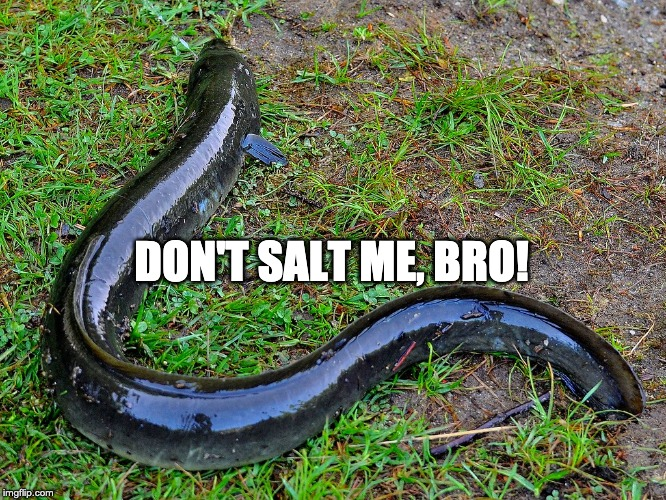
But Henry goes on to tell us that all of Simon’s scheming and maneuvering proved his undoing. He made himself such a nuisance to so many people at court that he eventually found himself imprisoned and exiled. Henry thinks that Simon’s metaphor of choice unusually, if accidentally, apt. Henry wrote that, “Just as salt is ruined by the eels’ moisture, so he [Simon] was destroyed by the whispering of all.” (Sicut sal anguillarum destruitur humore, sic ipse omnium aspiratione adnullatus est.)[7] Having succeeded in drawing out the slime from those around him, Simon became corrupted by it.
Henry calls Simon’s original statement a prediction, but one which the boy did not fully appreciate. This section of the letter concludes with the admonition that Walter should be wary of those young men who seem to have all the charm and money, as they often fall victim to vice, sin, and ill-fortune. Henry’s writing here is pretty smug; he was clearly feeling self-satisfied at having understood the full meaning of the metaphor when poor Simon did not.

Notes
[1] Ego curialibus interponor quasi sal anguillis uvuentibus. Henry of Huntingdon, Historia Anglorum, 596–97.
[2] Sicut enim sal anguillas excruciate, sic delationibus suis omnes regi famulantes distorsit. Henry of Huntingdon, 596–97.
[3] This is essentially identical to killing slugs and snails with salt, but on a much grander (and more grotesque) scale.
[4] David M. Forrest, Eel Capture, Culture, Processing and Marketing (Surrey, England: Fishing News (Books) Ltd., 1976), 154; J. Horne and K. Birnie, “Catching, Handling and Processing Eels” (Torry Research Station: Food and Agricultural Organization of the United Nations, 2001), http://www.fao.org/wairdocs/tan/x5915E/x5915e01.htm; Richard Schweid, Consider the Eel (Chapel Hill: University of North Carolina Press, 2002), 134.
[5] Forrest, Eel Capture, 154.
[6] Günter Grass described this process in The Tin Drum when he wrote that eels “wriggle themselves to death in the salt.” Günter Grass, The Tin Drum, trans. Breon Mitchell (Boston and New York: Houghton Mifflin Harcourt, 2009), 138.
[7] Henry of Huntingdon, Historia Anglorum, 596–97.
The post Like Salt Among Live Eels: A 12th-Century Saying appeared first on The Eels of History: Dead Fish Stories.
]]>The post Welcome! appeared first on The Eels of History: Dead Fish Stories.
]]>If you are interested in contributing please contact me with your ideas.
The post Welcome! appeared first on The Eels of History: Dead Fish Stories.
]]>